

Introduction: The empowerment of women is a widely discussed issue for long at all levels, from global to local. Since women constitute half of the population of the nation, many policy makers identify women in a categorized group, focusing on highlighting the context of women, often adopting a politically correct position, but inadequately both in material and ideological terms. As we step forward to become a global community, enhancing measures of demographic attributes appears unavoidable. Therefore noticeable efforts are evident for greater participation of women in local administrative and functional bodies like Panchyats and other civic bodies for ensuring access in the decision making process. Apart from political participations, various social institutions and Non-Governmental organizations are also engaged in uplifting women’s life and conditions, primarily centering three interrelated areas, education, health-care system awareness and economic empowerment.
Biological identity of women has always been decisive for assigning the gendered social presentation as primary. And this is a universal reality across culture, society and class, though in form and appearance for contextualizing their specificities. Hence structural, cultural and psychological mindset is functioning in favour of a system where women are perpetually disadvantaged and at the receiving end, though in varying degree and form, depending on specific socio-historical context of their situation. The context of physical and sexual dimensions of women as gendered object reflect another reality of sufferings, and women are trapped in this discourse that places them as perpetually vulnerable and susceptible as victim. Sexual violence, in particular is most effective in limiting women’s freedom of movement, thought and expression, and as a consequence their immediate dependence on male centered institutionalized pattern for security. This conformity is passing through evolutions and always endorsed by the dominant discourse of sexuality resulting direct control on women’s life and body. This perception of security is not only operative as a platform for the distribution of power or lack of it, but also appearing decisive for defining normality through women’s conformity towards stated standard and expectation. It has also been largely successful for defining the desired space for women explicitly through their selection of occupation in public sphere. These precise terms of preference and priority are also reasserting this dependence on this predefined notion of sense of security and meaningfulness. But more interestingly this is rooted in the conformity with the expected roles and functions within the family in the ‘private sphere’ under marriage (and even before and beyond marriage as well) in gendered terms, centrally focusing on care and unpaid for services. Greater the intensity of unquestioned commitment to these roles and services, greater would be the adoration and acknowledgement for the woman as ideal.
The problem
Gendered identity of women has constrained women’s thought, actions and consciousness across culture, time and space. Hence any attempt to understand or initiative to improve women’s social position through empowerment must not avoid bypass this constraint of gendered reality. Otherwise all attempts to include women into the journey of betterment are destined to be cosmetic and would be inadequate to address the obstacles. In general women’s position appears to be improved comparing their earlier social conditioning, especially in terms of their educational attainment, participation in economic activity and their space in public life. But the most pertinent question is how do these actually contribute to the change from within and more specifically impact on their awareness as human being beyond their ‘gendered self’? Democracy as a spirit is unlikely to be democratic when it fails to embrace the majority and unable to ensure the participation of the most within its spectrum and would suffocate being comfortable with half of the population being passive, docile, dependent and secondary.
Besides, the socio-political consciousness of women is crucially important for all varieties of empowerment that hardly received any sincere attention in any sense, certainly for political reasons. The state of consciousness has always been neglected by the conscious choice of the authorities (male-centered) being ideologically insensitive. As the politics behind these ‘politically correct’ measures of empowerment are to ensure that women as a collective must and should be placed unfailingly at the receiving end and the measures extended to uplift the condition should not jeopardize the existing power structure which is fundamentally draped with patriarchal essence. One major popular explanation for this lack or justification of this indifference was based on the belief that since consciousness is conceived as a natural byproduct of the measures related to educational exposure, economic independence etc., separate focus on addressing the issue of consciousness from within is not that relevant. But it is necessary to reevaluate these claims as women in general across culture did not reflect any such trends. And even if they do contribute to enhance some degree of self-righteousness of women, that too would be bound and limited by ideological slavery to the patriarchal lineage. There is no ambiguity reflected in their roles and none of these are considered as exceptions for their roles, being conditioned to play the role of representative social institutions of a given socio-political order and ideology.
Keeping this problem in mind, I planned this study to explore women’s lives and thoughts in order to capture a tentative extent of their consciousness which might have some impact on their over saturated gendered identity. Mainly three aspects of women’s life, education, economic independence and social exposure which are always widely considered as crucial means for upgrading their state of living conditions and to comprehend the extent of effective empowerment in their lived life. All of these together and also individually considered decisive in making women’s presence visible in the male dominated world and appeared as the only way to make a dint in the uninterrupted continuum of male-centered institutional network. Since the present Indian context the proportion of women engaged in public sphere with an independent engagement with a stable income is not very high, a more informed and critical understanding and perception were expected from this educated community
In this study an attempt has been made to explore women’s realities in everyday life from two different categories for evaluating the comparative role of different social agencies in this process of raising consciousness and thereby empowerment. Since development of consciousness is itself a complex process, especially in the context of societal agencies’ duality and contradictory positions, its reflection in women’s social awareness can be imagined, if they reflect an extent of critical evaluation of their lived experiences in spite of the resonance of entangled androcentric social realities. We will limit our focus here only on education and its impact on empowerment of women, because of their presence in public sphere and elaborated social exposures, primarily due to their economic independence also for the advantage of their social status.
Theoretical Premise for this study:
One of the most important interventions in the study of social realities since mid-twentieth century is the study of gender. This has led to the development of various feminist paradigms and continually creating possibilities of exploring newer dimensions for understanding of gendered issues, context and structures of our present and past.
This study assumes that all social interactions are gendered which are guided by the status, roles and awareness of the behavior assigned to the roles. Both institutional and ideological coordination are equally effective in the process of making this aberration convincingly functional, acceptable and hence Normal and legitimate, almost without any critical challenges in the mass psyche both in public and private sphere. Sexism and discrimination are natural consequences of these discriminatory practices and the status and role of female and male become stereotyped.
Sex (the biological component of male and female) and gender (the social and psychological component) are often confused and frequently used to mutually justify and rationalize all discriminatory practices. The contrast between male and female exclusivity being Instrumental and Expressive form as advocated by the Functionalist is considered as one such attempt of justifying gender discrimination for status-quo. Marxian advocacy of unequal power relation based on gendered role distributions is acceptable till the point it is free to accept beyond the clutches of class identity. Interactionists’ understanding of ‘Doing Gender’ is supportive to connect the lived experiences but fails to grasp the complexities because of its indifferences to acknowledge the patriarchal intervention of wider power structure for contextualizing the meaning of the micro situations.
From this position, this study embraces a theoretical paradigm which borrows the ideological struggle from the Feminist Marxist with the central critique on the discourse of sexuality as initiated by the Radical Feminist. In this venture most pertinent question is “empowerment through consciousness” and critique against establishing equity through referring shared spaces in various domains which were not accessible to the women to this extent. This might look impressive in terms of statistical representation of increasing share and presence of women, but that remains fundamentally cosmetic and superficial as the complexities of gendered graze is immensely colossal and the counteract can begin only through initiating a change from within. Acquiring the ability to evaluate and critique the women’s unquestioned appreciation of Normality, defined by an androcentric structure for the suitability of the hegemony of masculine culture and conformity to the patriarchal gawk in order to ensure the degrees of apparent convenience in our lived life. This premise has been conceptualized as the ‘consciousness from within’, the fundamental and the most crucial point of beginning for the journey of “empowerment through consciousness”.
Methodological Approaches:
Therefore the focus and scope of this study was very precise and limited to only one specific area of our multifaceted social complexities and differentiated stratified realities. But this chosen area has been marked on the merit of being ensuring maximum exposures of the subjects from both categories. All the working women were inhabitant of, in and around the city of Kolkata and engaged in working in the institutions within the core of the city that are comparatively equipped with all modern facilities and exposures. Housewives too, were generally educated and residents of in and around the city and kept them themselves aware with the help of different mediums of mass media. The data collection period was little over six months during the late 2018 and early 2019.
The analysis of this study is mainly based on primary data, as mentioned earlier, collected through administering a detailed self-explanatory questionnaire on a selected sample group chosen through convenient sampling maintaining anonymity. Therefore the information revealed through the collected data is used more for in depth understanding of the stated objectives and not for large scale generalization, also statistical analyses and allied significance test did not appear necessary. However definite trends and significant conclusion can be drawn from the results.
There are altogether hundred respondents have returned their filled questionnaire out of a total distribution of two hundred and ten respondents which is nearly fifty percent, certainly well above the general response pattern for using the mailed questionnaire as a tool for primary data collection. This distribution was designed to ensure adequate representation from both groups of women that is working and non-working categories. However, in spite of approximately equal distribution of questionnaire, response pattern was significantly better from working categories compare to the non- working group. Consequently out of the total filled questionnaire two third were from the working category while one third were from non-working women. Both English and Bengali languages were used to print two independent sets of questionnaire, and distributed according to the convenience or preferences of the respondents. As we have used a considerable number of open- ended questions, many interesting observation were found from both categories of women.
Research Findings:
Prologue:
This study first attempted to compare the differences in perception among the two groups of women who were conditioned by objectively identifiable contrasting social locations. One of the two segments enjoys considerable extent of economic independence being earner and also a significant extent of exposures in public sphere due to their own engagement. While the other segment of women remained confined primarily with domestic responsibility being full time homemakers were economically dependent on their husbands’ or family incomes. Apart from this difference in social location, contrasting educational attainment level between them were also appeared to have determining effect as all the respondents from the working women group were engaged in teaching at educational sector. More significantly most of these working respondents were in higher educations, both in the under-graduate and post-graduate levels with having Master degree as minimum qualifications. Although many full-time housewives were also having Bachelor’s degree and others are having a minimum of high school education which is useful for coping with their everyday requirements and also expressed some thoughtful insights through their understanding of the experiences of their lived lives. Nevertheless the other group of women with their educational attainment and social exposures in public sphere along with their economic independence were expected to reflect greater insight to the gendered issues of everyday life. And beyond this, they were also likely to have impact on their consciousness through their understanding of different dimensions of life especially being the practitioners of education being engaged in teaching to the generations of students at different levels. Hence these three significant variables that is income, education, social status and access in public sphere, women were expected to have reflections between these two contrasting segments through their various response pattern, since these are considered crucially vital for the empowerment of women which has been widely accepted at all levels.
In this paper, an attempt is made to explore the respondents’ social settings in order to locate them in this complex social positioning especially in reference to their education, age and working status. Next I tried to explore the relationship between the perceptions of education on attitude based on the primary quantitative data. collected through the questionnaire. One of the most significant indicator of women’s life is their exclusive time of their and their experience in education system have also been explored. And finally women’s understanding of the reasons behind the increasing violence against women and issues related to sexuality were examined.
The Context of Education:
Education is always considered as one of the crucial parameter both enhancing consciousness and empowerment and accepted as most valid means to implement all forms of inequalities and discriminations. This is not only for enhancing greater ‘life – chances’ for individual and collectives but also for leaving an impact on general perception and thereby on consciousness and actions. While exploring various issues related to education and its evaluation a range of different opinions have come up but they failed to suggest that the extent of education as a determinant have played any precise roles indicative of superior consciousness and evaluation.
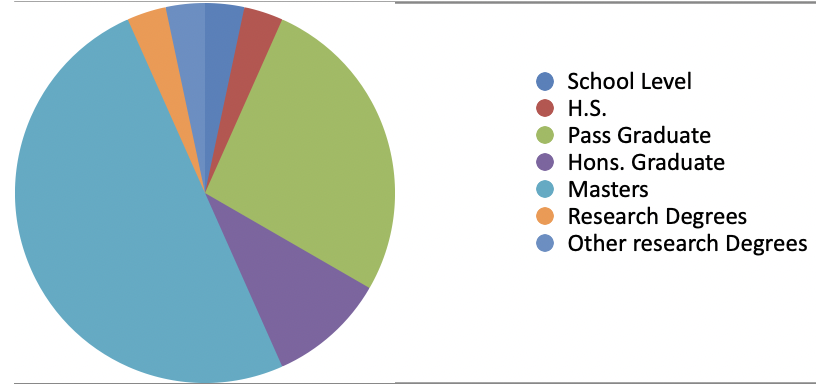
The following Pie diagram would more clearly represent the respondents’ distribution in reference to their educational attainment which would reflect a highly contrasting representation comparing Indian scenario.
Distribution of Respondents based on Educational Attainment
Age wise distribution reflects, between 18 to 25 years age group there are only 3 per cent of respondents, while around 20 per cent of the representation came from the 46 to 50 years category. Around 10 per cent respondents were there from each of the 26-30, 41-45, 56-60 and 60+ year’s categories. While 31-35 years and 36-40 years categories represented around 14 per cent of the respondents. Around 10 per cent of the respondents did not specify their ages. In other words, if we take the category between 31 to 50 years, we find that almost 55 per cent representations came from this age bracket.
Education and Evaluation:
Therefore, according to the selected sample, the attainments of formal educational qualifications were quite contrasting to the Indian scenarios. For example, literacy level for women is only around 59% and women having graduation and above barely comprises 3%of total population. However in urban areas the women’s educational level is slightly higher. But in spite of higher levels of basic education up to the extent of graduation and above the response pattern on the evaluative questions were did not reflect much insight or thoughtful or critical awareness. For example, on asking what one should aim to reach through formal educational achievement, many were imprecise or even did not response.
Table 4:
Respondents’ expected achievement/ outcome through education
| Expected achievement/ outcome | Respondents |
| Self Sufficient | 0 |
| Independent | 0 |
| Empowered/critical | 0 |
| Knowledgeable | 3 |
| Socially acceptable/ honoured | 2 |
| To build up good society and equal gender relation | 0 |
| can’t say | 25 |
| To be a good human | 23 |
| Socially responsible | 2 |
| Attainment of good standard of living | 45 |
| Total | 100 |
Almost half of the respondents considered education as a means of better standard of life while almost 30% of respondent hardly preferred to be precise through opting ‘can’t say’. Next significant group comprising over 20% expected that the outcome of this education system could be producing good human being. Significantly none of the respondents even connected this with the equality of gender relations.
While responding another two immediate questions regarding whether do they think Present system of education is facilitating those goals and whether this education also make us better/superior human beings, similar uncritical responses were noticed.
Table 5:
Respondents’ of perception Impact of present education system
| Present Education Facilitates to achieve these Goals | Education System produces Better Human Beings | |
| Yes Certainly | 0 | 1 |
| To an extent, yes | 7 | 9 |
| Not really | 13 | 10 |
| Not at all | 30 | 41 |
| can’t say | 29 | 19 |
| Don’t Know | 15 | 16 |
| others | 6 | 4 |
| Total | 100 | 100 |
While responding the question on whether present education system facilitates achieving the stated goals almost half the respondents, 45% to be precise,together either said ‘Can’t say’ or ‘Don’t know’ and nearly 35% respondents followed the same pattern for the question regarding whether education system helps us to grow as better human beings. For both the questions a huge number of respondents 34% for the first question and over 46% for the second question replied negatively. Only partial positive reply was given by somewhat around 10% of the respondents for these issues.
Regarding identifying the negative or limiting aspects of our present education system, I have noticed another set of interesting responses. Though following the trend of avoiding to answer requires greater thoughtfulness and critical thinking again reaffirmed as over 35% of respondents have either said ‘can’t say ’ or ‘don’t know , having educational back ground of all kinds, nearing half the respondents identified two issues as the sole reason. Out of these two types, 25% of the total respondents have pointed out changing teacher- student relationship is the main drawback of the present system while around 20% singled out Obsolete Curriculum as the reason. Among the others, three reasons defective assessment system, absence of applied dimensions and quality deterioration are responded by 5 to 8% of total respondents for each of these categories and interestingly only one respondent specifically said that it is due to its connectedness with the present life.
The table 6 would more aptly represent their responses and almost negligible number of respondents expressed any opinion hardly reflecting any element of critical consciousness of our present education system or process, even when the respondents themselves were the practitioners of educations and engaged in imparting the same education within the same system.
Table 6:
Respondents’ perception of limitation of the Present Education system
| Major limitations/drawbacks of present system of learning | |
| Not connected to life | 1 |
| Deffective Assessment system | 5 |
| Quality deterioration | 7 |
| Teacher-student relationship | 23 |
| Obsolete Curriculum | 17 |
| Can’t say | 23 |
| Don’t Know | 18 |
| Absence of applied dimension | 6 |
| Total | 100 |
.
Violence and Victims:
In reference to a question regarding how to address the problem of rape, respondents suggested as many as ten different reasons besides one fourth of the total that is almost 25% were not having any suggestion for it and almost taken for granted without any provisions for redressing. Those who have addressed this menace have suggested scattered and discrete means to bring it under control without reflecting any trend which varied from 3% to 12% and these cutting across the educational attainment of the respondents. The choices varied from introducing effective laws(10%), to social awareness(9%), through resistance (10%)to women’s consciousness (6%), from the respect expectation from the men(3%) to appropriate education for women(7%), from the unity of women(12%) to self sufficiency of women(6%), from the expectations of social compassion(7%) to the imagination of women’s bravery(5%). The table below can represent this doldrums of women more suggestively.
Table 7:
Respondents’ Educational Qualification and Suggestions for Addressing the Problem of Rape
Opinion
| Education | Through effective Laws | Through social awareness | Through resistance | Through women’s consciousness | Male should learn to respect women | Appropriate education | Women should be self-sufficient | Society should change/ Compassionate society | Women should be brave | No Anws | Grand Total |
| School Level | 0 | 0 | 0 | 0 | 0 | 0 | 0 | 3 | 0 | 0 | 3 |
| H.S. | 0 | 0 | 0 | 0 | 0 | 0 | 0 | 0 | 3 | 0 | 3 |
| Pass Grad | 4 | 0 | 7 | 0 | 3 | 3 | 3 | 0 | 0 | 7 | 27 |
| Hons. Grad & B.Ed | 3 | 0 | 4 | 0 | 0 | 0 | 0 | 0 | 0 | 3 | 10 |
| Masters | 3 | 7 | 0 | 7 | 0 | 3 | 7 | 3 | 7 | 13 | 50 |
| Research | 0 | 4 | 0 | 0 | 0 | 0 | 0 | 0 | 0 | 0 | 4 |
| Professional | 0 | 0 | 0 | 0 | 0 | 0 | 3 | 0 | 0 | 0 | 3 |
| Grand Total | 10 | 11 | 11 | 7 | 3 | 6 | 13 | 6 | 10 | 23 | 100 |
Reasons for increasing violence against women is another important issue for making women’s existence especially vulnerable compares to others fellow beings. Similar portrayal is reaffirmed in another related question regarding reasons for increasing violence against women. Responses varied from individual to collective responsibilities, form regional/local cultural factors to wider social structural conditions as the causes being responsible for this which naturally does not suggest any specific trend or indication of their understanding of this crucial issue of their existence. The respondents’ perception increasing violence against women in reference to their education, as the table below suggests, are scattered over another ten different reasons with extreme contrast like women themselves are responsible through their provocative dresses (12%)to moral degradation of society (22%) in one extreme to patriarchal power structure (11%)and consumerist capital society (7%) and male sexual orientation (3%)at the other. In between issues like lack of confidence (3%) to lack of education and women’s physical weakness (17%), media’s active construction and highlighting of these issues (7%) role of governmental indifference (4%)also featured their concern. Around 14% skipped the question and avoided responding. Further detail can be drawn from the table 8
Table 8:
Consciousness against Increasing Violence against Women in Reference to their Educational Qualification
Assessment
| Education | moral degradations/ to satisfy ego | provocative dresses/ behavioural pattern of some women | Patriarchal power structure | male sexual orientations | Lack of appropriate education/ women are physically weak | Capitalist, consumerist society | It also happened before, but media is more prompt now | Lack of confidence | Lack of governmental initiative | (blank) | Grand Total |
| School Level | 0 | 0 | 0 | 0 | 0 | 0 | 3 | 0 | 0 | 0 | 3 |
| H.S. | 0 | 0 | 3 | 0 | 0 | 0 | 0 | 0 | 0 | 0 | 3 |
| Pass Grad | 3 | 10 | 0 | 0 | 4 | 3 | 0 | 0 | 0 | 7 | 27 |
| Hons. Grad & B.Ed | 3 | 0 | 3 | 0 | 0 | 0 | 0 | 0 | 4 | 0 | 10 |
| Masters | 13 | 2 | 5 | 3 | 10 | 4 | 3 | 3 | 0 | 7 | 50 |
| Research | 0 | 0 | 0 | 0 | 3 | 0 | 1 | 0 | 0 | 0 | 4 |
| Professional | 3 | 0 | 0 | 0 | 0 | 0 | 0 | 0 | 0 | 0 | 3 |
| Grand Total | 22 | 12 | 11 | 3 | 17 | 7 | 7 | 3 | 4 | 14 | 100 |
Ironically the sufferers or the victims of this system have confused themselves for the very basic reason that women look for the shelter and protection from the very same set of rescuer who they consider as potential perpetrators or offenders in some other situations. In other words they are looking for shelter and protection from those males who themselves are potential threat to some other women. Or more simply protectors and offenders are not fundamentally different in essence since this is defined by their power locations within the larger social fabric which may appear different in different social context but never principally questioning this power arrangements since the very construction of the heterosexual discourse of normality is placing women as an object of sexual pleasure and continuously interpreted and interrogated for the suitability of male gaze. Women are placed in this deal at the receiving end and almost with insignificant degree of negotiating capacity as this heterosexual discourse very successfully transform the struggle of the women in to a struggle against women, by making every single woman as a tool and medium for this hegemony. This distortive view of normality and ideality and its hollowness is very evident in their response to a related question which is very expressive of dilemma in what to expect from the marriage.
While exploring the alternative marriage preferences, the Issue of dependence on male members for security and psychological reasons can be viewed from other perspectives as well. Generally male members particularly husbands are viewed as bread winner of the family therefore employed male with unemployed female is most acceptable marriage combinations with distinctive role divisions in public and private sphere. Next preferred combination is also quite acceptable where both partners are working though role allocation of male and female partners are majorly remains unaltered. The reverse of the first combination that is employed female and unemployed male as marriage combinations are less likely to be appreciable as the conformity of dependence on male being normal and the reverse is not. Thus the social roots of dependence on male protector much deeper than it appear to be. This is very clearly reflected when the responses against the proposition of accepting the marriage between their earning daughter with their unemployed friend and compared to their educational status and employment. In spite of being hypothetical and imaginary nature of the question only around 35% responded positively while almost equal number of respondents (33%) directly rejected the possibility. Around 17% imposed conditions which again were rooted in some kind of respectful masculine engagement even being unemployed and ability take responsibilities of a male head were significant and suggestive to my proposition. Along with this another 15% preferred not to be responsive about this issue. Interestingly many of those who have responded positively do not having any scope for experimentation being either not having any daughter at all or already got them married in the normal format.Therefore they responded more openly as they can reflect apositive image, especially being earner but without being responsible to implement it. Table 9 represents the picture in greater details.
Table 9:
Educational Qualification and Opinion about Earning Daughter Marrying Unemployed Friend
Opinion of the Respondents
| Education | Yes | No | Conditionally Yes | (blank) | Grand Total |
| School Level | 3 | 3 | |||
| H.S. | 1 | 2 | 3 | ||
| Pass Grad | 7 | 14 | 6 | 27 | |
| Hons. Grad & B.Ed | 4 | 2 | 4 | 10 | |
| Masters | 10 | 16 | 6 | 18 | 50 |
| Research | 4 | 4 | |||
| Professional | 3 | 3 | |||
| Grand Total | 28 | 36 | 14 | 22 | 100 |
Another interesting fact was revealed when the respondents expressed their perception about their husband. Over three forth of the total respondents have considered their husband as friend while 17% considered either superior or guardian. In a different context while responding to another related question- who do they trust most to disclose and share everything they want to, only 24% have referred to their husband as preferred person, in spite of the fact that over three times of this number have leveled their husband as friend. This could be explained by two apparent reasons; either they don’t get enough interactive time and opportunity to share all details with their husbands or they were conscious of the implication and wanted to appear as politically correct to describe their social terms and relationship with their most intimate partner. Interestingly most of the respondents those who did not count their husband for this, opted for a woman, either being a friend, or younger sister or mother as the substitute. Only 3% looked at their husband as human and all the respondents were from 60+ age group, while remaining 3% perceived their husband is the combination of all these.
Conclusion
All these dimensions are clearly suggesting that our education system centering the attainment of degrees through examinations has absorbed the spirit of androcentric hegemonic order very effectively and appropriately been wrapped up by the patriarchal values, thoughts and actions prevalent within the wider structure governing our expected social behavior. Through this structural and institutional process of education, reproduction of the existing order is almost destined to perpetuate the domination and denial of women within it and certainly insufficient to enable women for making informed and determined evaluation of their existing realities from a point of a critique. Hence irrespective of the educational exposures and attainment, the extent of responses remained largely same on several issues concerning their everyday existence. More interestingly, it was not just educational qualifications alone, but most of the times powered with economic independence (or just earnings) along with the exposure of sharing public space beyond domesticities did not make any significant impact in their world of meanings of the conventional point of view in gendered terms, strongly challenges the popular myth of the empowering women through education and economic independence.
The issues related to their notion of ideality of different roles and individualities have aptly reaffirmed the all sorts of gendered conformities and expectations in connection of their everyday realities. A very few respondents raised unorthodox observations but that too inconsistently. A large number of respondents either ignored or remained indifferent to answer these questions which too were expressive of their conscious reluctance to explore issues which are generally not very encouraged unless structured in the expected social format.
Interestingly, though an overwhelming number of respondents (over 90%) considered marriage is very significant in women’s life and its provides stability and security in most given situations, still almost all of them believed that sexual violence particularly rape is very common within marital relations. This legitimacy of rape under the institution of marriage makes it unpleasant but hardly recognized or recorded as offence, far beyond the possibility of exploring the provisions for redressing it. Therefore the very institution (marriage) that has been chosen for providing the security and avoiding the menace of sexual interferences on women’s body is itself ratifies and facilitates those activities and establishes an unquestioned control over it. Only difference is that it is not subjected to the public gaze and free from stigma and perhaps endorsed to an extent by the wider dominant context since this performed by authorized and sanctioned person that is husband, which in effect reiterates the androcentric power and control of the prevailing culture. Therefore it is wiser to be silent and develop skills for adjustment to these situations as normal as a means of their survival strategy and normality and without implicating any negativity.
Since the very construction of the heterosexual discourse of normality is placing women as an object of sexual pleasure and continuously interpreted and interrogated for the suitability of male gaze. Women are placed in this deal at the receiving end and almost with insignificant degree of negotiating capacity as this heterosexual discourse have very successfully transformed the struggle of the women into a struggle against women, by making every single woman as a tool and medium for this hegemony. This distortive view of normality and ideality and the superficial understanding is very evident in their consciousness and practice to different questions which are very aptly expressive of their dilemma regarding the expectation from the marriage.
Thus traditional educational attainment coupled with economic independence did not make any significant impact in their world of meanings comprised of conventional gendered point of view and strongly challenges the popular myth of the empowering women through education and economic independence.This study also strongly questions the prevalent belief that consciousness is a natural byproduct of the educational exposure and economic independence and demands separate focus and measures on consciousness from within educational curriculawith true gender sensitivity and structuring the process of institutionalization accordingly. This is hardly feasible on any single institution and needs an all-round holistic struggle free from all kinds of stigmatization, marginalization and objectification.
References
Bal, Vidya (2011): “Re-defining Feminism: A Personal Note” in Ranjana Harish and V. BharathiHarishankar (Eds.) Re-defining Feminisms, Rawat Publications, New Delhi, India..
Banerjee, Nirmala (2011): “Socio-Economic Analysis of Reproduction and the Family” in Nirmala Banerjee, SamitaSen and NanditaDhawan (Eds.) Mapping the Field: Gender Relations in Contemporary India, Readings in Gender Studies 1, Vol.1, Stree, Kolkata, India.
Bonner, F., L. Goodman, R. Allen, L. Janes and C. King (Eds.) (1992): Imagining Women: Cultural Representation and Gender, Polity Press in association with The Open University, London, UK.
Burck, C. and B. Speed (Eds.) (1995): Gender, power and relationships, Routledge, London, UK.
Chakravarti, Uma (2009): “Formation of Patriarchy and the Subordination of Women” Ch.4 in Gendering Caste: Through a Feminist Lens, Stree, Kolkata, India.
Crompton, Rosemary (2008): “Gender and Work” in Kathy Davis, Mary Evans and Judith Lorber (Ed.) The SAGE Handbook of Gender and Women’s Studies, SAGE Publications Ltd., London, UK.
Eisenstein, Zillah (ed.) (1979): “Capitalist Patriarchy and the Case for Socialist Feminism”, Monthly Review, New York, USA.
Fenstermaker, Sarah and Candace West (2002): Doing Gender, Doing Difference: Inequality, Power, and Institutional Change, Routledge, London, UK.
Holmes, Mary (2010): Gender and Everyday Life, Routledge, Taylor and Francis Group, New York, USA.
Jana, S. and S. Lahiri (2012): Women’s Issues: Political and Economic Perspectives, Books Way, Kolkata, India.
Kramer, Laura (2011): The Sociology of Gender: A Brief Introduction, Rawat Publications, New Delhi, India, pp.25-113.
Mies, Maria, VeronikaBennholdt-Thomsen and Caludia von Werlhof (1991): Women: The Last Colony, Second Impression, Zed Books Ltd., London, UK, pp.65-127.
Moitra, Shefali (2002): Feminist Thought: Androcentrism, Communication and Objectivity, MunshiramManoharlal Publishers Pvt. Ltd. in Association with Centre of Advanced Study in Philosophy, Jadavpur University, Kolkata.
Oakley, Ann (1976): Woman’s Work: The Housewife, Past and Present, Random/Vintage New York, USA.
Panjabi, K. and P. Chakravarti (Eds.) (2012): Women Contesting Culture: Changing Frames of Gender Politics in India, School of Women Studies, Jadavpur University and Stree, Kolkata, India.
Smith, Dorothy E. (1989): The Everyday World as Problematic: A Feminist Sociology, Northeastern University Press, Boston, USA.
Vanita, Ruth (2011): “Thinking Beyond Gender in India” in MaitrayeeChaudhuri (Ed.) Feminism in India,Issues in Contemporary Indian Feminism (Series Ed. RajeswariSunderajan), Kali for Women, New Delhi, India.
Walby, Sylvia (1990): Theorizing Patriarchy, Basil Blackwell Ltd., Oxford, UK.
Wittig, Monique (1992): “One is not Born a Woman”, in The Straight Mind and Other Essays, Beacon Press, Boston, USA.
Woodward, K. (2012): The short guide to gender, Rawat Publications, Jaipur, India.